
Apparently, I Have a Sales Philosophy
Aug 27, 2026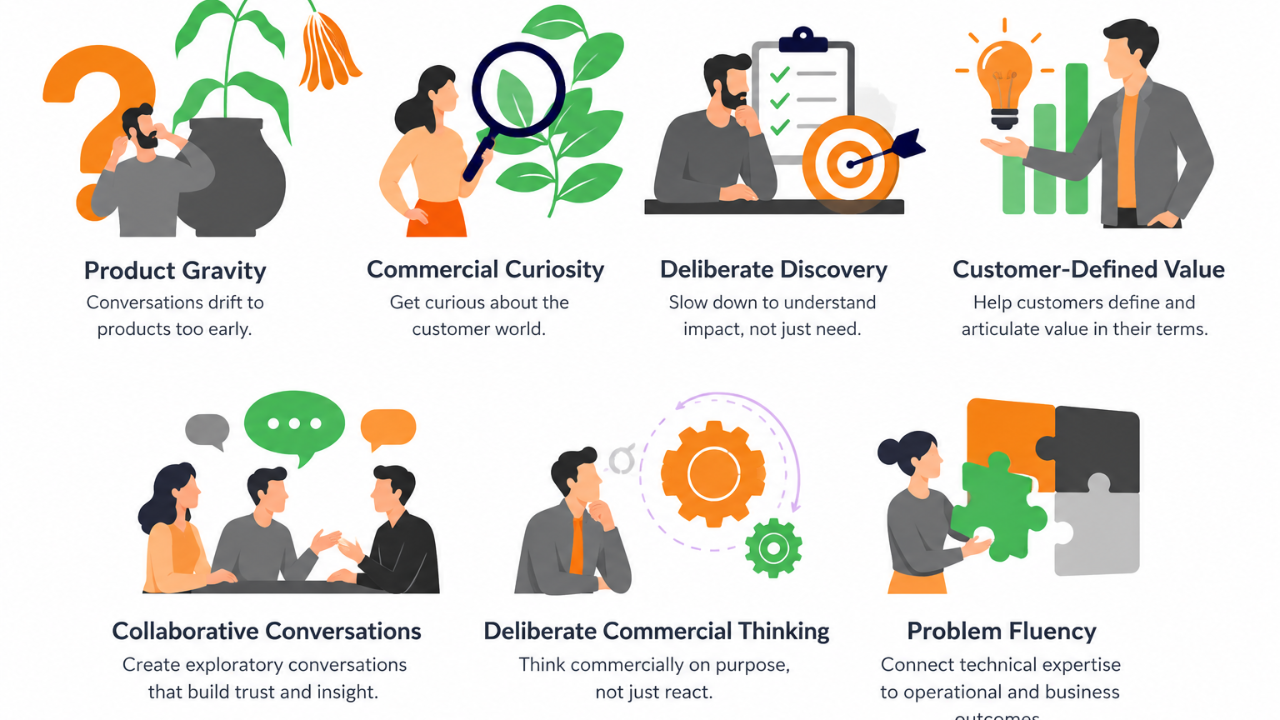
This might be the most self-indulgent article I've ever written.
It's all about me.
How I think about selling.
The philosophy I've developed.
The pillars that sit underneath it.
The practical framework I use.
And, while we're at it, the products I've built around all of that.
So yes...
Pretty self-indulgent.
Or is it?
Well, yes. A bit.
But there's a reason I'm sharing it.
None of this started with me sitting down and thinking, "I need some intellectual property."
It came from more than 25 years of working with salespeople, watching what happens in real commercial conversations, borrowing good thinking from other places, testing ideas, changing things and trying to make sense of what consistently works.
I've always called that 'professional curiosity'. Looking for ideas that can make me, and the people I work with, better at what we do.
And increasingly I've realised that all that thinking fits together.
Philosophy. Pillars. Practical Framework. Products.
(Yes, they all begin with P. Sometimes these things just have to be done.)
I'm sharing the whole lot here.
Partly because it might explain how I think.
More importantly, because some of it might be useful in how you think.
Anyway... you be the judge.
Philosophy
Commercially Stronger Conversations.
That's really what sits at the heart of everything I do.
In complex B2B sales, particularly engineering and manufacturing, customers are rarely short of information.
What they are dealing with is complexity, risk, operational pressure, competing priorities, internal alignment and the consequences of getting a decision wrong.
So I don't think our primary job is to persuade them.
I think it's to support them in making good commercial decisions.
And that requires commercially stronger conversations.
For me, one of the most important shifts within that philosophy is From Product to Problem.
Technical people naturally talk about technical things: products, specifications, capabilities, performance and features.
Of course they do.
They know this stuff. They're proud of it. And customers often ask about it.
I'm certainly not suggesting technical salespeople should know less about their products.
Quite the opposite.
The issue is when the product enters the conversation too early and becomes the conversation.
Because the customer is usually dealing with something much broader: downtime, labour, capacity, efficiency, risk, growth, confidence or some other operational or commercial issue.
The product matters. But the product is rarely the whole conversation.
Moving from Product to Problem means understanding that wider picture before deciding where your technical expertise fits.
That's the philosophy.
Not abandoning the product. Making the conversation around it commercially stronger.
Pillars
Once I started looking at sales conversations this way, I kept noticing the same things.
I've ended up capturing seven of them as Commercial Pillars.
They're not seven commandments of selling. They're patterns worth paying attention to.
Product Gravity
Technical conversations naturally gravitate towards products, machinery, specifications and features.
The problem isn't talking about the product. It's getting there too early.
If we haven't properly understood the problem first, it's very easy to end up in a technical comparison where price becomes increasingly important.
Commercial Curiosity
Strong technical salespeople aren't only curious about the requirement. They're interested in the customer's wider world.
Why does this matter? What else is happening? What are the consequences? Who else is affected?
Curious salespeople often uncover better opportunities.
Deliberate Discovery
Technical people are generally pretty good at solving problems.
That's useful, unless we start solving them before we've properly understood them.
Sometimes the most commercially useful thing a salesperson can do is slow down, ask another question and resist the temptation to provide the answer.
The strongest technical sellers often speak later.
Customer-Defined Value
Everyone talks about value.
The problem is that suppliers and customers don't always mean the same thing.
We might see technical superiority, output, precision or innovation. The customer might care more about downtime, staffing pressure, reliability, implementation risk or confidence.
Value isn't something we announce.
We need to understand what the customer actually values.
Collaborative Conversations
This one goes right back to my first book Selling Through Partnering Skills
Customers can feel the difference between being sold to and working something through with someone.
Collaboration doesn't mean being passive or avoiding commercial conversations. It means approaching them as partners trying to reach a sound decision.
Trust, win-win thinking, interdependence, feedback, future orientation and comfort with change were all part of the partnering thinking I started applying to sales years ago.
I still think they matter.
Deliberate Commercial Thinking
Sales can become very busy.
Emails answered. Quotes produced. Meetings attended. Opportunities chased. CRM updated.
Plenty happening.
But activity and progress aren't the same thing.
Sometimes the commercially sensible decision is to prepare more carefully, ask another question, qualify something out or invest your time somewhere else.
Busy doesn't always mean commercially effective.
Problem Fluency
Technical expertise becomes much more valuable when it can be connected to operational and commercial impact.
Can we talk confidently about the customer's problems, consequences, constraints and desired outcomes as well as we can talk about our own products?
That's Problem Fluency.
Features explain. Problems connect.
So those are my seven Pillars.
Things I keep seeing. Things I think influence whether a conversation becomes commercially stronger.
Which is all very nice.
But what do you actually do with them?
Practical Framework
This is where the VALUE Framework comes in.
I've been using it for years. It first appeared in Selling Through Partnering Skills as a practical way of bringing different approaches to selling together with a partnering mindset.
Today I explain it very simply.
🔸Validate - right opportunities
Are we working on the right things?
Is there a genuine fit?
Should we pursue this opportunity at all?
And is it right for the customer as well as us?
🔸Align - right research
What do we need to understand?
The organisation. The people. Their pressures. Their priorities. The wider environment around the opportunity.
Good conversations tend to start before the meeting.
🔸Leverage - right conversations
This is where Commercial Curiosity and Deliberate Discovery really come into play.
Explore the problem.
Understand the consequences.
Find out what matters.
And resist Product Gravity long enough to understand what you're actually trying to solve.
🔸Underpin - right solutions
Now the product gets to do its thing.
Because technical capability can be connected to a problem the customer recognises and value they've defined.
The solution becomes commercially relevant rather than merely technically impressive.
🔸Evolve - right outcomes
What happened?
Did the customer get the outcome they expected?
What have we learned?
What should happen next?
Because the outcome is ultimately the test of whether all those earlier decisions were sound.
And that's why I call it a Practical Framework rather than a process.
Selling isn't conveniently linear.
Things happen together.
We learn something and go back.
Priorities change.
Different people become involved.
New information changes our thinking.
The framework gives us a way to think about what we're doing without pretending every complex sale follows five tidy steps.
The Philosophy gives us the belief.
The Pillars give us things to pay attention to.
The Practical Framework gives us a way to operate.
Which brings us neatly to the most commercially self-indulgent P.
Products
I sell stuff.
There, I've said it.
Because a Philosophy, seven Pillars and a Practical Framework aren't particularly useful if nobody does anything with them.
I've said for years:
Implementation beats information.
So I've built different ways for people to put the thinking into practice.
The Collaborative Selling Accelerator supports teams going deeper and embedding the thinking into how they actually sell.
The Engineering Sales Academy provides a scalable learning environment.
Diagnostics and scorecards provide a way to understand what's happening now and where conversations could become commercially stronger.
Workshops, webinars and keynotes give us somewhere to kick the ideas around.
And books, articles, podcasts and other content allow me to share much of the thinking more widely.
Different ways of engaging with it.
Same underlying philosophy.
So, after 25 years of working in this stuff, I've somehow ended up with a reasonably simple architecture:
Philosophy
Commercially Stronger Conversations, with From Product to Problem as a central shift in how we create them.
Pillars
Seven recurring patterns that influence the quality of those conversations.
Practical Framework
The VALUE Framework
Right opportunities. Right research. Right conversations. Right solutions. Right outcomes.
Products
Different ways of putting it all into practice.
So was this all about me?
Yes.
I warned you.
An entire article about how I think, the ideas I've developed, the framework I use and the things I sell.
But perhaps there's something useful underneath it.
You don't need my Philosophy.
You don't need my Pillars.
You certainly don't need to lift the VALUE Framework.
But I do think there's value in working out:
-
What do we believe about how our customers buy?
-
What consistently gets in the way?
-
What does good look like?
-
How do we turn that thinking into something people can actually use?
That's essentially what I've done.
It just took me 25 years to realise I'd done it.
So perhaps this article wasn't entirely about me after all.
Although... it mostly was.
Are you ready to increase your sales?
The Collaborative Selling Scorecard has been designed to show sales professionals their blind spots and provide instant, actionable steps on how to improve
It’s free and only takes 5 minutes
